





The Mosquito Bowl: The Tragic Fate Of Football Stars In WWII
 193cc Agency CouncilNovember 28, 20265 Mins read
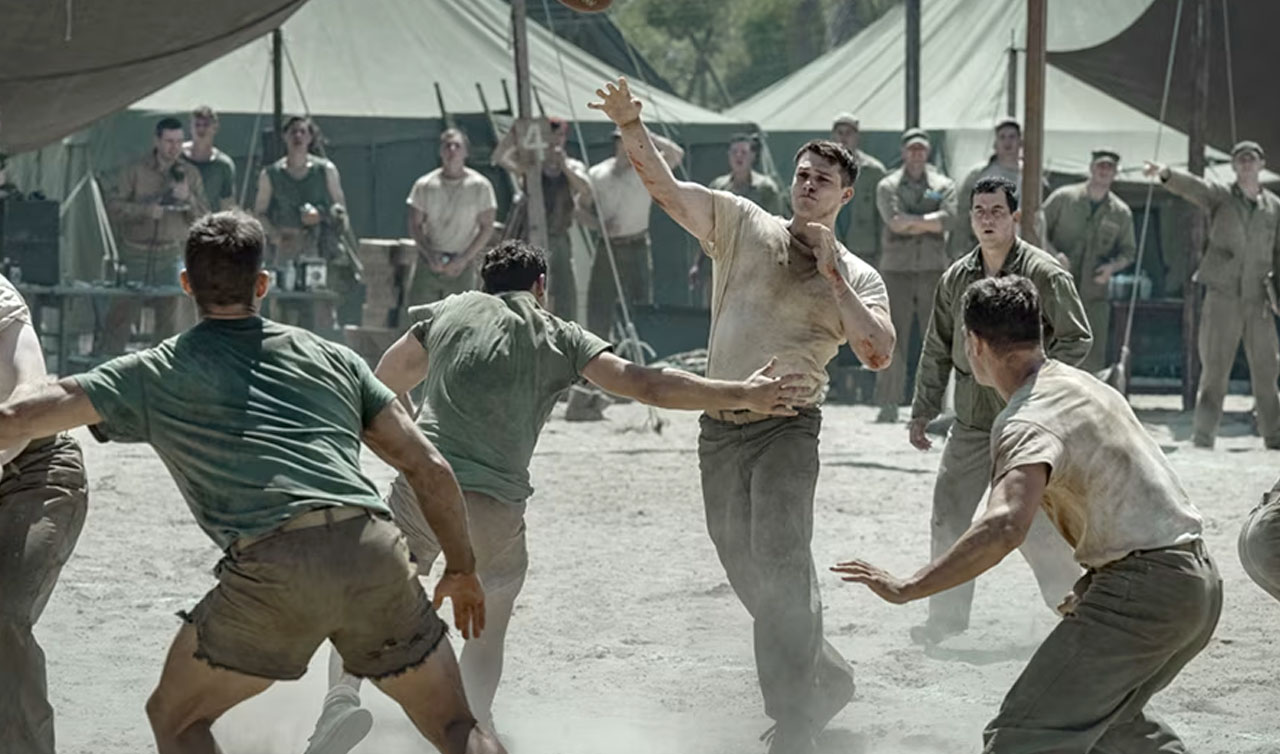
A remarkable chapter of American football and World War II history has inspired Netflix’s latest historical war drama, The Mosquito Bowl. The film revisits the extraordinary story of talented college football players who abandoned promising sporting careers to serve in the U.S. Marines following Japan’s attack on Pearl Harbor in 1941. Although the players once dreamed of professional football careers, many would never return home from the battlefield.
Directed by Peter Berg, known for Friday Night Lights and Lone Survivor, the film premiered on Netflix on November 25. The cast includes Nicholas Galitzine, Bill Skarsgård, Ray Nicholson and Tom Francis, who portray four real-life football players whose experiences during the war form the central narrative.
The story is inspired by Pulitzer Prize-winning author Buzz Bissinger’s 2022 nonfiction book, The Mosquito Bowl: A Game of Life and Death in World War II. Bissinger’s research uncovered a personal connection to the events, as his father had served at Okinawa with the 4th Marine Regiment, one of the two military units involved in the historic football matchup. His father rarely discussed his wartime experiences, according to Netflix’s Tudum.
Berg sought to present the players as more than celebrated athletes or military personnel, focusing on their personal relationships, ambitions and the lives they left behind. Describing his approach, the director told Netflix that the film explores young men who were sports heroes at home before becoming war heroes in the Pacific. He wanted audiences to understand them as athletes, sons, teammates, rivals, brothers, friends and husbands whose shared dreams were disrupted by war.
The original Mosquito Bowl was held on Christmas Eve, December 24, 1944, on Guadalcanal in the South Pacific. The contest emerged from a competitive rivalry between the 4th and 29th Marine Regiments, whose members each believed their unit had the stronger collection of football talent.
The teams featured an impressive group of former college athletes, including three All-Americans and seven former college football captains. Players represented universities from across the United States, making the event an unusual gathering of some of the country’s most accomplished football talent during wartime.
Despite the considerable ability on both sides, neither team managed to score, and the game finished in a 0-0 draw, according to the Marine Corps Association’s Leatherneck magazine. Marine veteran Neal McCallum, who witnessed the event, recalled the closely contested matchup during an October 2026 interview with CBS News. He described it as a great game played back and forth, explaining that the teams were evenly matched.
McCallum also remembered that the players wanted another opportunity to compete. However, the colonel of the 4th Marines refused to approve a rematch because he was concerned about injuries ahead of the military operation the troops were preparing to undertake.
That operation would become the invasion of Okinawa in April 1945, just over three months after the football game. The battle proved devastating for the former athletes. Of the 65 men who participated in the Mosquito Bowl, 15 were killed during combat.
While developing the film, Berg traveled to Okinawa to visit locations associated with the battle. At a peace memorial dedicated to those who died, he encountered several names that had become familiar through his research, including Butkovich, Bauman, Schreiner, McLaughry and George Murphy. Speaking to Tudum, Berg recalled that seeing those names affected him deeply and strengthened his determination to tell their story.
Among the four central football players portrayed in the film, John McLaughry was the only one to survive World War II. His story, along with the lives of Bob Bauman, Dave Schreiner and Tony Butkovich, illustrates the devastating consequences of the conflict for a generation of young athletes.
McLaughry, portrayed by Nicholas Galitzine, played college football at Brown University, where his father, DeOrmond “Tuss” McLaughry, served as head coach. He became captain of the university’s football team and was selected by the New York Giants in the third round of the 1940 NFL Draft. However, his professional playing career lasted just one season before he entered military service with the Marines.
During the war, McLaughry became known for his leadership and composed approach. Bissinger described him to Tudum as a dependable figure who listened to others, avoided unnecessary risks and earned the respect of those around him. After surviving the conflict, McLaughry returned to football through coaching. He eventually went back to Brown University, serving as its head coach between 1959 and 1966. He died on November 28, 2007, at the age of 90 following a lengthy illness.
Bob Bauman, played by Bill Skarsgård, was a standout football player at the University of Wisconsin, where he developed a close friendship with teammate Dave Schreiner. The Chicago Bears selected him in the 24th round of the 1943 NFL Draft, but his military commitments prevented him from pursuing a professional career.
On June 6, 1945, Bauman took command of A Company, 1st Battalion, 4th Marines, during the Battle of Okinawa. Japanese machine gun fire struck his unit on the same day, killing him in combat. He was subsequently awarded the Bronze Star posthumously in recognition of his military service, according to the University of Wisconsin’s Gold Star Honor Roll.
Dave Schreiner, portrayed by Tom Francis, established himself as one of Wisconsin’s leading football talents between 1940 and 1942. Playing for the Badgers on both offense and defense, he earned All-American recognition twice. In his final college season, he shared the team captaincy, received the Big Ten’s most valuable player award and became only the second Wisconsin football player to appear on the Heisman Trophy ballot.
The Detroit Lions selected Schreiner in the second round of the 1943 NFL Draft. However, like several other players involved in the Mosquito Bowl, he put aside professional football to serve in the Marines. During the closing days of the Okinawa campaign in June 1945, Schreiner was shot while conducting a patrol. He underwent surgery at a field hospital but died from his injuries the following day. Wisconsin later retired his No. 80 jersey, and he was inducted posthumously into the College Football Hall of Fame in 1955.
Tony Butkovich, played by Ray Nicholson, was another exceptional athlete whose football career was cut short by the war. Nicknamed “Touchdown Tony,” he initially played for the University of Illinois before a military training program transferred him to Purdue University in 1943.
His single season with Purdue produced remarkable results. Across seven games in 1943, Butkovich accumulated 833 rushing yards, the highest total nationally that year, and scored 16 rushing touchdowns. That touchdown figure remains a Purdue school record shared with Kory Sheets. He also scored 78 points in four conference appearances, establishing a Big Ten scoring record that stood until 1962.
The Cleveland Rams selected Butkovich with the 11th overall pick in the 1944 NFL Draft. However, he never had the opportunity to begin his professional football career. On April 18, 1945, less than four months after the Mosquito Bowl, he was killed by a Japanese sniper during the Battle of Okinawa.
The Mosquito Bowl remains a poignant reminder of the young athletes whose sporting ambitions were interrupted by World War II. While the historic game ended without a single point, its participants faced consequences far beyond the football field. Netflix’s film brings their experiences and sacrifices to a wider audience through a story connecting American football history with the realities of wartime service.
The Mosquito Bowl is now streaming on Netflix.






Related Articles
Chris Pratt’s Warrior Kid Gets 22% On Rotten Tomatoes, Audiences Disagree
Chris Pratt’s latest family drama, Way of the Warrior Kid, has received...
Whalefall Heads To Digital After $39.1 Million Box Office Run
The deep-sea survival thriller Whalefall, featuring Austin Abrams and Josh Brolin, is...

ViX Launches AI-Generated Microdrama Inspired By Classic French Novel
TelevisaUnivision is introducing a new AI-driven vertical drama through its streaming platform...

David Fincher Embraces AI and Digital Filmmaking for Cliff Booth Sequel
David Fincher is pushing the boundaries of digital filmmaking and artificial intelligence...
Leave a comment