





Xpeng Challenges Tesla With One AI System for Cars and Robots
 193cc Agency CouncilNovember 26, 20264 Mins read
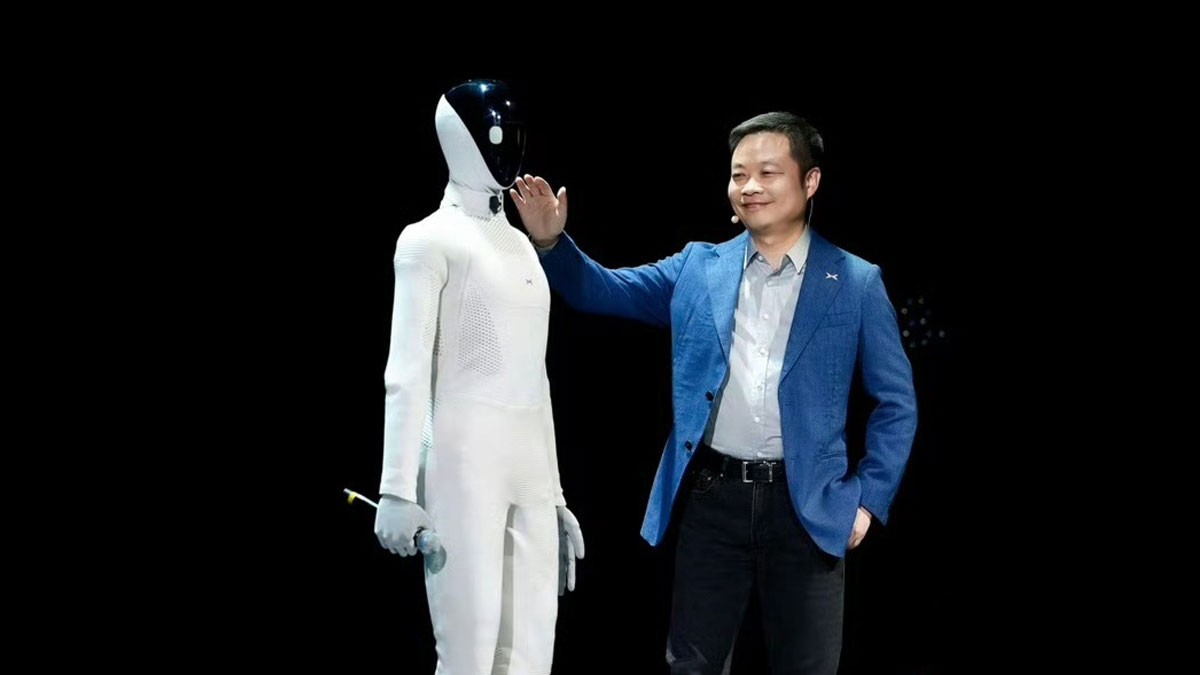
Tesla and Chinese electric vehicle manufacturer Xpeng are pursuing different strategies to expand into humanoid robotics, but both companies share a vision of using artificial intelligence developed for vehicles to power multiple types of machines. While Tesla is reallocating factory capacity from traditional vehicles toward humanoid robots and autonomous taxis, Xpeng is building an integrated AI platform designed to operate cars, drones, flying vehicles and robots using a common intelligence system.
At its eighth AI Day in Guangzhou, China, Xpeng introduced its Turing Physical AI Architecture, a unified computing and intelligence platform intended to control its growing range of machines. The company, which delivers more than 400,000 vehicles annually, also introduced WorldGPT, a world model designed to support six categories of machines: cars, boats, drones, single-arm robots, dual-arm robots and humanoid robots.
Xpeng’s latest developments place its Iron humanoid robot at the center of its broader robotics ambitions. The company plans to begin training Iron to work as a store assistant at its retail locations during the first quarter of 2027. An official public release is scheduled for the second quarter of that year, potentially putting the robot in customer-facing environments before Tesla’s Optimus becomes widely available outside the company.
Tesla, meanwhile, is making significant changes to its manufacturing operations to accommodate robotics and autonomous transportation. The automaker ended production of the Model S and Model X this year, with the final vehicles leaving its Fremont, California, factory in May. The freed-up manufacturing space is being repurposed for Optimus humanoid robot production.
In its October third-quarter update, Tesla confirmed that Optimus manufacturing had started on high-volume production lines in Fremont. The company described the robots as its first production-quality units. Earlier this month, CEO Elon Musk also indicated that Cybertruck manufacturing at Tesla’s Texas facility would be reduced around mid-2027 to create additional capacity for Cybercab robotaxis.
Tesla continues to manufacture and sell vehicles, with the Model 3 and Model Y accounting for almost all its deliveries. Cybercab is also part of its automotive business, although it is designed for driverless transportation. Nevertheless, the company’s manufacturing priorities increasingly point toward autonomous vehicles and robotics rather than expanding its conventional passenger car lineup.
Xpeng is taking a different approach, arguing that automotive and robotic technologies can develop together rather than compete for resources. Chairman and CEO He Xiaopeng said the industry needs to move beyond developing increasingly sophisticated AI models and focus on connecting intelligence with physical interaction.
“For years, the AI industry has focused on making the brain smarter. But humans do not learn through the brain alone. We learn by touching, moving, trying, failing and trying again. I believe Physical AI must evolve in the same way,” He said. He explained that the company’s approach focuses on developing the intelligence and physical capabilities of machines together, allowing AI systems to understand their surroundings, perform practical tasks and improve through real-world experience.
Xpeng’s Turing architecture divides machine intelligence into three interconnected layers. System 0 handles essential body operations, including power management, energy, communications and physical movement, ensuring machines operate within their capabilities. System 1 uses the company’s VLA 2.0 model to process environmental information and translate perception into real-time actions. System 2 provides higher-level reasoning through vision-language task planning and the management of complex, multi-stage objectives.
The same architecture is designed to operate across Xpeng’s vehicles and humanoid robots. The company says these platforms share computing resources, data infrastructure, control systems and safety technologies. It also uses knowledge from automotive research, testing and manufacturing to accelerate the development of its robotics products.
For its vehicles, Xpeng has developed the X-VMC 2.0 motion control system, which coordinates propulsion, braking, steering and suspension. One of its latest features, VLA Adaptive Deceleration, analyses road conditions and adjusts regenerative braking when drivers release the accelerator. During urban traffic congestion testing, the technology delivered 12.4% more usable driving range compared with operating without energy recovery. Xpeng also reported that accident claims involving its vehicles in China declined by nearly 14% following the introduction of VLA 2.0.
Its Iron humanoid robot incorporates 76 degrees of freedom, allowing movement across numerous joints and body components. It also features more than 1,500 tactile sensing points covering over 80% of key body areas, providing greater physical sensitivity and awareness of nearby people and objects. Three of Xpeng’s proprietary Turing AI chips power the robot.
Training for these systems takes place at Xpeng’s Robot Data Factory, which covers more than 250 scenarios and 15 different job categories. The facility helps develop the data and practical experience required for robots to perform tasks in different environments.
WorldGPT represents another important part of Xpeng’s strategy. The model is designed around the idea that different machines often need to understand similar physical relationships. For example, an autonomous vehicle calculating the distance to another car and a robotic arm estimating its distance from a coffee cup both require an understanding of spatial relationships and movement. Xpeng aims to train a large-scale physics-based model using information from vehicles, drones, robotic arms and humanoids. That shared knowledge is then transferred into smaller models tailored to the capabilities and requirements of individual machines.
Both companies are also progressing with autonomous transportation. Tesla already operates driverless robotaxi services in several U.S. cities and has conducted Cybercab rides in Austin. Xpeng is developing its own robotaxi capabilities through a training programme and operational testing in Guangzhou. Its purpose-built autonomous vehicle, the YOYO-01, is expected to arrive in 2027.
In humanoid robotics, Xpeng could have an advantage in bringing a product into a real-world working environment sooner. Tesla’s Optimus manufacturing facility in Fremont is reportedly designed to eventually produce approximately one million robots annually, but the company has shared relatively limited public demonstrations of its production robots. Xpeng, by comparison, has outlined a timeline for introducing Iron into its retail stores in the first quarter of 2027, followed by a public release in the second quarter. Although retail assistance represents a relatively controlled application, it would provide a practical demonstration of the robot operating around customers.
Despite their different approaches, Tesla and Xpeng have several important similarities. Both companies develop their own AI chips and use automotive data, engineering and technologies to support robotics research. Their strategies are built around the belief that a common AI foundation can reduce development costs and accelerate the introduction of new intelligent machines.
The biggest distinction lies in the role each company assigns to its automotive business. Tesla increasingly views its existing vehicle operations as the foundation that will finance its future in robotics and autonomous transportation. Xpeng, on the other hand, sees cars as an integral part of a broader physical AI ecosystem in which vehicles, robots and other machines share the same underlying intelligence.

Related Articles
Kaleidescape Brings Disney Movies to UK and Australian Platforms
Kaleidescape has expanded its premium movie and television download service in the...
iPhone Air Hits Record-Low $799 Price Ahead of iPhone Air 2
Apple’s ultra-thin iPhone Air has received its biggest price reduction yet, with...
HEDD Audio Launches $1,199 HEDDphone DX Flagship Headphones
HEDD Audio has unveiled the HEDDphone DX, a new flagship pair of...

Lenovo’s AI Infrastructure Boom Drives Revenue Up 48%
Lenovo is strengthening its position in the global technology industry as rapid...
Leave a comment