





QuiX Unveils First Deployable Universal Photonic Quantum Computer
 193cc Agency CouncilJuly 14, 20262 Mins read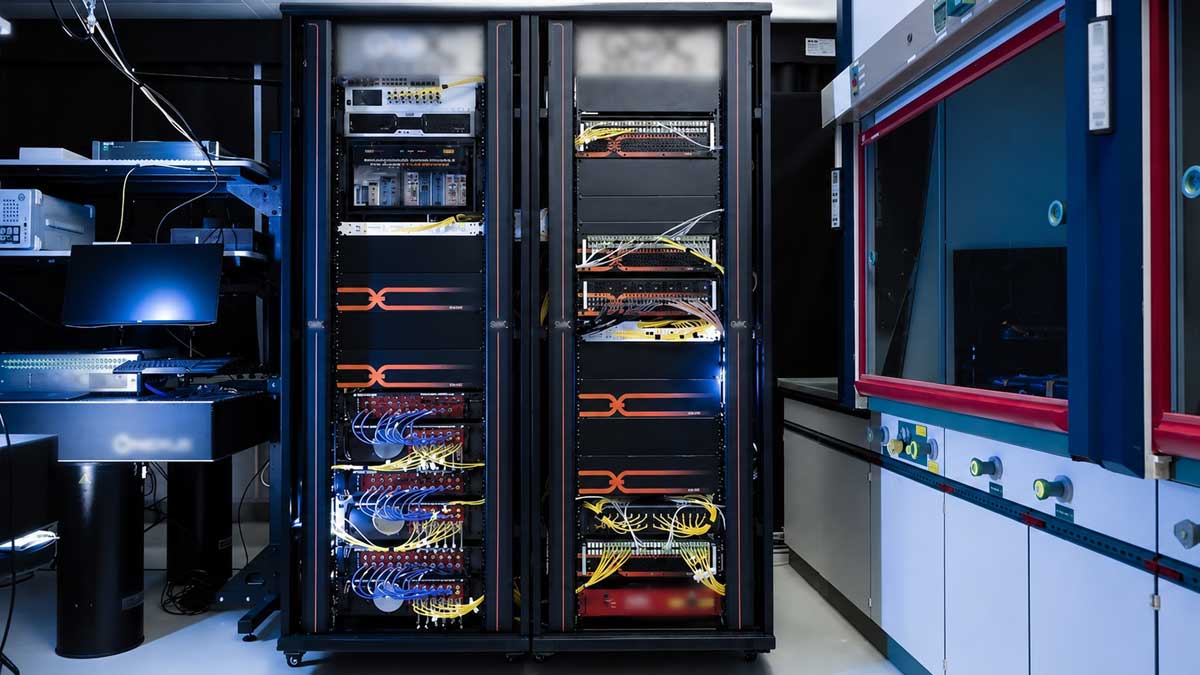
Netherlands-based QuiX Quantum has introduced Carina, which it describes as the world’s first universal photonic quantum computer built for deployment in customer environments rather than specialized research laboratories. Unlike most quantum computers that rely on cryogenic cooling, Carina operates at room temperature, fits into standard data center racks and uses single photons as its physical qubits, making it suitable for integration alongside conventional computing infrastructure.
The new system features eight input photonic qubits and four computational photonic qubits, with the company planning to rapidly expand its capabilities. Gerard J. Milburn, a professor at the University of Queensland and an early pioneer of photonic quantum technology, said, “What QuiX Quantum is showing with Carina and its measurement-based approach is that this path is not only tractable but navigable with integrated photonics. It moves the conversation from whether photonic quantum computing can be universal to how quickly it can be scaled.”
Carina was developed as part of the Universal Photonic Quantum Computer project under the German Aerospace Center’s Quantum Computing Initiative (DLR QCI), funded by the German Federal Ministry of Research, Technology and Space. QuiX Quantum confirmed that the core hardware has already been delivered to DLR QCI.
The system’s defining feature is its universal architecture. Previous photonic quantum computers were primarily designed for specialized tasks, such as boson sampling, and could not be reprogrammed to execute arbitrary quantum algorithms. Carina, by contrast, is designed to implement a universal gate set, enabling it to run any gate-based quantum algorithm in principle. At its current scale, the platform is intended to demonstrate algorithms including Shor’s, Grover’s, Deutsch-Jozsa and quantum teleportation rather than solve commercially meaningful problems or break encryption.
Instead of implementing quantum gates directly in hardware, Carina uses a measurement-based computing model. The system creates a highly entangled cluster state and performs adaptive single-qubit measurements, with each measurement influencing the next through high-speed feed-forward control. A compiler converts conventional gate-based quantum circuits into these measurement-based operations, allowing standard quantum algorithms to run on the platform.
The hardware combines several technologies previously introduced by QuiX Quantum, including on-chip photon generation at room temperature, high-speed optical switching, multiplexing, cluster-state generation, a Feed-Forward Control Unit that converts detector signals into real-time control actions and a Photonic Assembly Control Unit that standardizes control across photonic chips. The company also recently demonstrated a production-ready form of below-threshold error mitigation on a photonic quantum computer, describing it as a first for a European quantum computing company.
Although Carina’s qubit count is modest, QuiX Quantum said its current objective is to validate the architecture rather than maximize qubit numbers. CEO Stefan Hengesbach compared the approach to the first transistor, emphasizing that proving the architecture is the foundation for future scaling in both qubit quantity and quality.
Hengesbach said Carina is designed to demonstrate a universal photonic platform that can be deployed directly in customer environments and integrated with classical computing and high-performance computing workflows. He noted that pricing varies because each installation is customized, with systems of this class representing multi-million-euro strategic infrastructure projects rather than fixed-price products.
The company differentiates its approach from other photonic quantum computing developers by focusing on room-temperature, discrete-variable photonics that can operate inside standard data centers instead of relying on cryogenic systems, proprietary facilities or quantum-as-a-service models. QuiX Quantum believes this strategy will allow governments, enterprises and HPC operators to build experience with on-premise quantum infrastructure before utility-scale systems become available.
Fault tolerance remains a long-term objective for the industry. Hengesbach said Carina establishes the universal architecture required for future logical qubits and large-scale fault-tolerant quantum computing. He added that measurement-based photonic systems may provide advantages for quantum error correction because photonic qubits support all-to-all connectivity, potentially reducing hardware requirements compared with traditional gate-based architectures. The company also believes native photonic interconnects provide a natural path toward scaling future quantum computing systems.




Related Articles
PocketBook Q eReader With E Ink Carta 1300 Debuts at IFA 2026
PocketBook is preparing to introduce its new PocketBook Q eReader at IFA...
Google Gemini for Home Update Brings Better Spotify Controls
Google has released a new update for its Google Home app and...

Garmin Fenix 9 Launches With Brighter OLED and 64GB Storage
Garmin has unveiled the Fenix 9, the newest generation of its flagship...


Keychron V6 Ultra Hybrid Combines Mechanical and Magnetic Switches
Keychron has launched the V6 Ultra Hybrid on Kickstarter, introducing a full-size...
Leave a comment