




NextSilicon Unveils Maverick-2 Architecture for AI and HPC
 193cc Agency CouncilNovember 21, 20263 Mins read
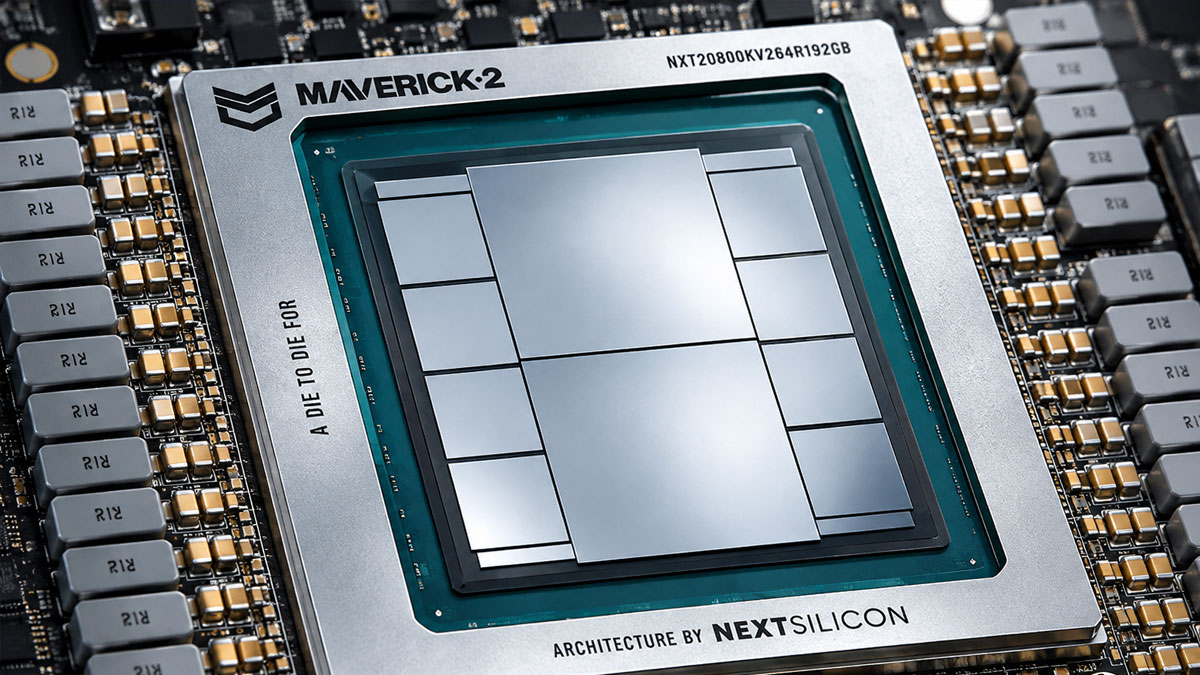
NextSilicon is introducing a different approach to high-performance computing and artificial intelligence with its Maverick-2 Intelligent Compute Architecture (ICA), a reconfigurable accelerator designed to improve computing performance and energy efficiency. The platform combines software-defined dataflow processing with a two-core RISC-V CPU, aiming to accelerate demanding scientific workloads without requiring developers to rewrite existing applications.
Unlike conventional GPU architectures built around programmable processing cores or application-specific chips based on fixed logic, Maverick-2 uses software to map computing tasks across an array of arithmetic logic units. Its reconfigurable design is intended to adapt hardware execution to different workloads, offering an alternative approach to traditional accelerators.
The system includes a two-core RISC-V processor featuring out-of-order execution and 256-bit vector processing. These cores handle scalar operations and control functions while supporting the accelerator’s dataflow processing. The design also aims to address some of the performance challenges associated with conventional dataflow architectures, where tracking available operands and coordinating instructions can introduce additional processing overhead.
A central part of NextSilicon’s approach is its software stack, which is designed to work with established programming languages and development frameworks. The compiler can translate C++, Fortran, Python, OpenMP, Kokkos and CUDA into an intermediate representation before automatically extracting dataflow graphs. This allows existing applications to use the architecture without requiring developers to adopt specialized dataflow programming languages. Support for AMD’s ROCm and HIP technologies is also under development.
The Maverick-2 hardware configuration features two 5-nanometer dies, eight HBM3e memory stacks and integrated RISC-V processing cores. The company also offers an air-cooled version built around a single die that consumes approximately half the power. A future generation is expected to include four CPU cores.
NextSilicon says Maverick-2 can deliver up to four times the FP64 performance per watt of Nvidia’s HGX B200 on selected scientific workloads. The company also claims more than 20 times the efficiency of Intel Xeon Sapphire Rapids processors for its targeted applications. These figures are company-reported performance claims, with further independent performance data still awaited.
The architecture supports native FP64 calculations, which are particularly important for scientific and high-performance computing workloads. Although FP64 processing requires more chip area than lower-precision computing units, NextSilicon has prioritized it over an NVFP4 floating-point unit. The company says AI inference workloads are often constrained by memory and data movement rather than raw computing capacity. Its design uses weight conversion to support AI model processing while maintaining its focus on high-precision computing.
The company’s initial market strategy centers on high-performance computing applications, including scientific research, national laboratories, hedge funds and geoscience businesses. It plans to expand further into AI and vector database workloads after establishing a stronger position in the HPC market.
NextSilicon also emphasizes automated software optimization. Its platform collects hardware telemetry, including information about memory utilization and application runtime behavior. These measurements feed optimization cycles that allow the software to recompile applications and refine performance. The company says this approach can support legacy applications, including software developed decades ago, without requiring manual code refactoring.
The company is also positioning Maverick-2 for a broader range of future AI architectures. While many specialized AI processors are designed primarily around transformer-based large language models, NextSilicon says its reconfigurable architecture can accommodate emerging approaches such as Mamba-style models and non-standard attention kernels. It aims to support changing AI workloads without requiring model fine-tuning or the substantial training investments described in the source.
NextSilicon’s strategy differs from approaches taken by companies such as Groq and SambaNova. While those competitors focus on maximizing token-generation speeds for individual users through memory-intensive designs, NextSilicon says it is targeting concurrent workload density, with a goal of supporting between 50 and 150 users across stacked units.
The company is already working with national laboratories to demonstrate the technology. NextSilicon and Sandia National Laboratories have partnered on Spectra, a 64-node supercomputer being developed under Sandia’s Vanguard program. The system will use Maverick-2 accelerators to evaluate alternative computing architectures for HPC, AI and nuclear deterrence simulation workloads.
NextSilicon also delivered four Maverick-2 accelerators to Los Alamos National Laboratory on November 16, 2026, during the SC26 conference. The units were installed in the laboratory’s Darwin testbed for evaluation.
The growing demand for energy-efficient computing has encouraged cloud providers and AI companies to develop alternatives to conventional GPU-based systems. NextSilicon is seeking to establish a place in this changing market by combining reconfigurable hardware, established programming tools and automated optimization. Its progress in national laboratory deployments will provide an opportunity to evaluate the architecture’s potential across scientific computing and future AI applications.




Related Articles

Stanford Study Finds Experience May Shield Workers From AI Displacement
A new update from Stanford University suggests that artificial intelligence is creating...

Tesco Tests AI That Could Build Your Shopping Basket
Tesco is expanding its use of artificial intelligence from predicting what shoppers...

AI Security Test Reveals Risks of Excessive Agent Access
A recent evaluation by the U.K.’s AI Security Institute (AISI) has highlighted...


IBM Says AI-Powered Cyber Breaches Surge as Attack Costs Climb
Artificial intelligence is playing an increasingly significant role in cybercrime, with IBM’s...
Leave a comment