





AI Boom Drives Holiday Electronics Prices Higher As Memory Costs Soar
 193cc Agency CouncilNovember 28, 20262 Mins read
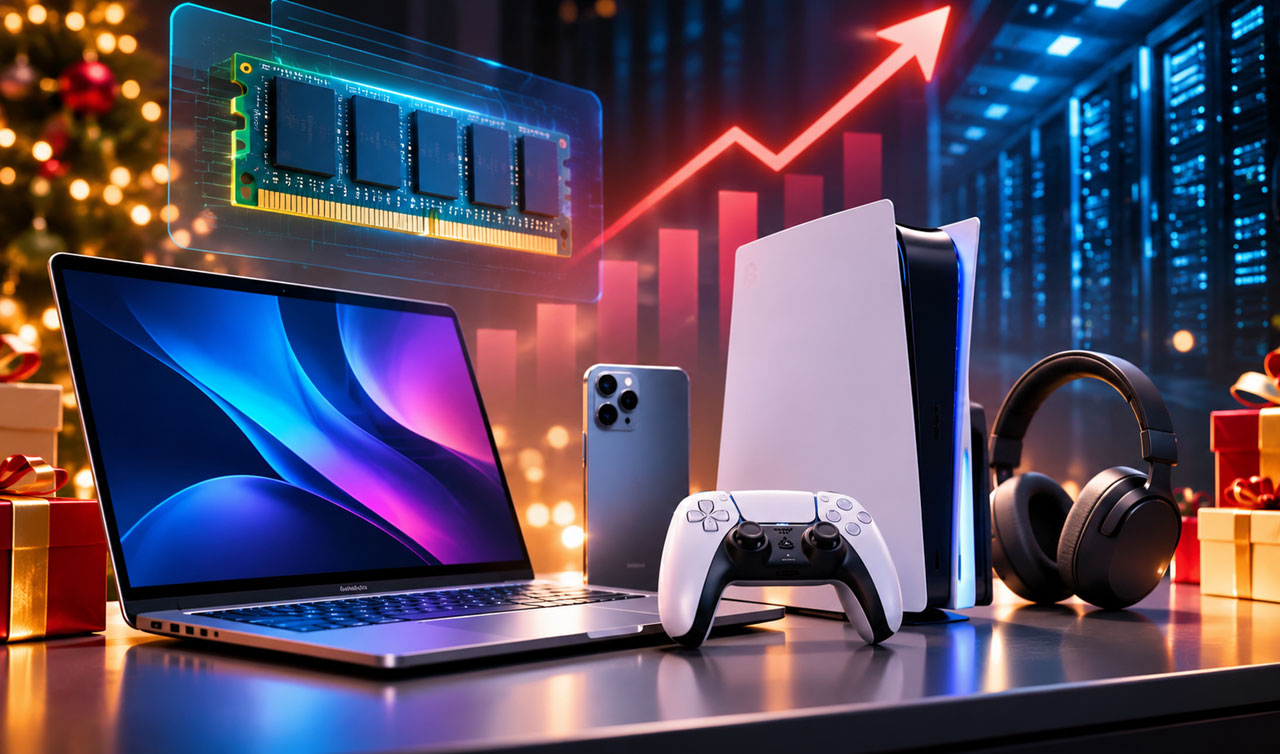
Shoppers hoping to buy laptops, gaming consoles and other electronic devices this holiday season are facing significantly higher prices. The main reason is a growing shortage of memory chips, driven by the rapid expansion of artificial intelligence infrastructure. As demand from AI companies pushes memory costs upward, electronics manufacturers are passing much of the additional expense on to consumers.
The impact is already visible across the technology market. Gaming consoles have become more expensive, laptop prices have climbed by hundreds of dollars compared with last year, and popular products from major manufacturers are increasingly costly. The pressure stems largely from AI data centers, which require enormous quantities of memory chips to support their operations.
Sassine Ghazi, CEO of semiconductor technology company Synopsys, told CNBC that a significant share of memory chips is “going directly to AI infrastructure,” leaving other industries “starved.” With manufacturers competing for limited supplies, companies producing consumer electronics are facing higher component expenses.
International Data Corporation estimated in October that memory costs had increased by approximately 350% compared with the previous year and were continuing to rise. The shortage has prompted companies including Apple, Sony and Nintendo to increase prices on popular products. New York Times product review publication Wirecutter has also been warning about what it describes as the “death of the cheap laptop.”
The PlayStation 5 provides a clear example of how much prices have changed. Sony’s online store currently lists the PS5 Pro at $899 and the standard PS5 at $649. At the same point last year, the two consoles cost $749 and $550, respectively, according to archived versions of the PlayStation store. That represents increases of roughly 20% for the Pro and 18% for the standard model.
The comparison with prices from two years ago is even more striking. The PS5 Pro was then priced at $700, while the standard console cost $425. The increases are particularly notable because gaming consoles have traditionally become less expensive as they age.
Apple devices have also become more costly. An iPhone 17 with 256GB of storage currently sells for $899, compared with $799 for the equivalent model a year earlier, based on archived pricing. Apple’s 14-inch MacBook Pro lineup has experienced an even larger increase, with starting prices now at $1,999, approximately $400 higher than the starting price at the same point last year.
Higher prices are also affecting consumer demand. Data from Circana previously shared with Forbes showed that U.S. spending on gaming consoles reached approximately $2.9 billion between January and September, a 9% decline from the roughly $3.2 billion recorded during the same period in 2025.
The worldwide computer market has also weakened. IDC reported last month that global PC shipments had fallen by more than 20% year over year in the third quarter of 2026. Jitesh Ubrani, IDC Research’s research director for consumer devices, said manufacturers were concerned about holding excessive inventory in a market where expensive products were discouraging purchases.
Smartphone shipments have experienced a similar downturn. IDC found that global shipments declined 22% year over year in the third quarter of 2026, marking the steepest annual drop on record. Nabila Popal, IDC’s senior research director for worldwide devices, warned that the situation could deteriorate further, saying the “worst is yet to come” as memory costs remain elevated.
The financial pressure is increasingly reaching shoppers rather than remaining with manufacturers and suppliers. Francisco Jeronimo, IDC’s vice president for worldwide devices, said in October: “The pressure is now moving from vendors to consumers. As higher prices reach the shelf, many buyers are keeping their current devices longer.”
With memory demand continuing to rise alongside AI infrastructure investment, the electronics industry faces growing pressure to balance component costs with consumer affordability. For holiday shoppers, that means popular gadgets could remain considerably more expensive than they were just a year ago.




Related Articles

Ex-xAI Founders Launch AI Time Machine To Improve Future Predictions
Three former members of xAI’s founding team have launched a new artificial...

Musk Warned SpaceX Was Falling Behind in AI, Report Says
SpaceX CEO Elon Musk reportedly raised concerns internally in August that the...

Meta AI Chief’s Superintelligence Warning Sparks Online Backlash
Meta’s chief AI officer Alexandr Wang has triggered widespread debate on social...

Nvidia’s AI Dominance Faces Growing Challenges From AMD and Google
Nvidia’s position at the center of the artificial intelligence computing market remains...
Leave a comment