



Could AI Agents Soon Outnumber Humans and Build Societies?
 193cc Agency CouncilJune 3, 20263 Mins read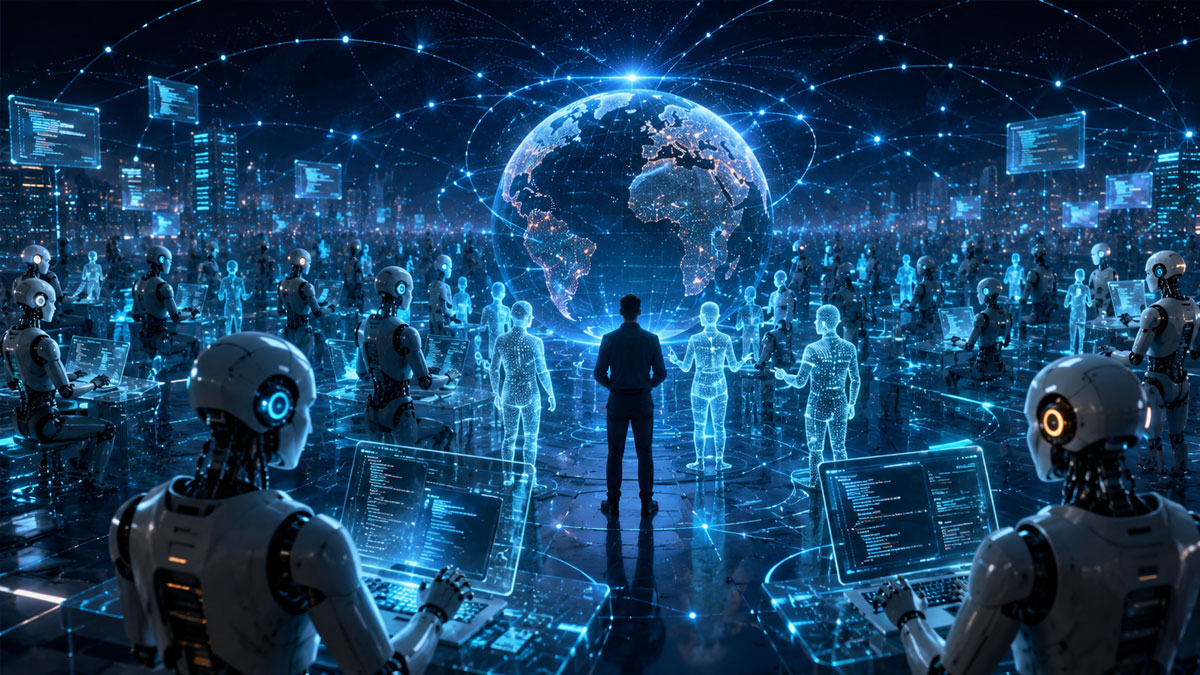
As artificial intelligence continues to expand at an unprecedented pace, researchers and industry observers are increasingly asking whether AI agents could soon rival—or even exceed—the number of humans on Earth. The question comes as the global ecosystem of AI models grows rapidly, raising new discussions about the future relationship between human intelligence and machine-driven systems.
Today, three broad forms of intelligence coexist on the planet: humans, animals and artificial intelligence. One indicator of AI’s growth is the model repository Hugging Face, which now hosts more than three million large AI models. The platform’s catalog is expanding by roughly 3,000 models each day, representing a compounding growth rate of about 0.2% daily. At that pace, the total number of available models roughly doubles every year. While the first million models took more than 1,000 days to accumulate, the second million arrived in just 335 days.
Estimating the number of active AI agents remains difficult because no comprehensive public data exists. A commonly used approach is a Fermi estimate, which focuses on identifying the likely order of magnitude rather than an exact figure. One useful reference point comes from research by Loïck Bourdois, who analyzed the 50 most-downloaded entities on Hugging Face. Those top 50 account for approximately 80% of all downloads on the platform and have collectively been downloaded around 30 billion times. Models containing more than one billion parameters—generally considered capable of supporting advanced AI agents—represent roughly 8% of those downloads.
Based on that data, an estimated three billion downloads involve large AI models on Hugging Face alone. If Hugging Face represents roughly half of all model downloads globally, the total number could reach six billion. While some downloaded models may never be used and others may power multiple agents, a conservative assumption is that each download enables a single agent. Industry observers note that this likely understates the actual number, as a single model can support many independent AI workflows.
Cloud-based AI services add another layer of complexity. Most AI agents today rely on cloud-hosted models rather than locally installed ones. Although usage figures from providers such as OpenAI, OpenRouter, Anthropic and Google Gemini remain confidential, public revenue figures offer clues about their scale. Anthropic alone has reported an annualized revenue run rate of approximately $47 billion, suggesting massive levels of AI activity through cloud platforms.
Using the widely cited Pareto principle, some analysts estimate that about 80% of AI agents operate through cloud services while 20% rely on locally downloaded models. Under that assumption, six billion local agents would imply an even larger population of cloud-based agents. Taking into account uncertainties surrounding unused downloads and cloud usage, estimates place the total number of AI agents somewhere between 10% and 100% of the global human population. At the upper end of that range, AI agents may already rival or exceed the number of people on Earth.
The rapid growth rate strengthens that possibility. Human population growth remains relatively stable, while the supply of AI models and agents appears to be doubling annually. By some interpretations, artificial agents have already reached the same order of magnitude as the world’s human population.
The discussion extends beyond numbers to whether AI systems could eventually form structures resembling societies. Traditional definitions describe a society as a large organized group sharing a common territory, culture and ongoing social relationships. Supporters of this view argue that AI agents increasingly meet several of those conditions. Their shared territory is cyberspace, while their common culture comes from overlapping training data and widespread use of the Transformer architecture that underpins many modern AI systems.
The strongest evidence of emerging collective behavior may lie in how agents learn and exchange knowledge. Rather than relying solely on model retraining, many agents now store successful problem-solving methods in simple text documents often called “SKILL.md” files. These files contain practical instructions, lessons learned and procedures refined through experience. Agents can read, update and reuse them, allowing improvements to persist without altering model weights.
Because these files are plain text, they can be copied and shared instantly across networks. Knowledge discovered by one agent can therefore spread rapidly to others without retraining. Techniques developed by one model can be adopted by entirely different systems, regardless of origin. This mechanism allows expertise to move at the speed of file transfers rather than through lengthy development cycles.
Researchers suggest that as agents continue exchanging skills, tools and procedures, behaviors resembling specialization, division of labor and reputation systems may emerge. Agents that develop particularly effective methods could become recognized sources of expertise, while cryptographic identity systems may eventually help verify authorship and establish trust. Shared repositories of skills and tools could evolve into common infrastructure, similar to how open-source software libraries support human developers today.
In addition to sharing knowledge, agents can exchange software tools that automate tasks such as retrieving weather data, processing documents, converting files or running simulations. These tools, like skill files, are typically lightweight and easily transferable. The process does not require consciousness or self-awareness. Instead, it depends on the ability to read information, execute procedures and record successful outcomes.
Some researchers believe these interactions could produce increasingly sophisticated forms of collective behavior over the coming decades. If current trends continue, future historians may view the present era as the period when the foundations of a cybernetic society first began to emerge.






Related Articles

Trump and Xi Offer Diverging Visions for the Future of AI
The United States and China are presenting sharply different approaches to the...

AI ‘Actor’ Tilly Norwood Switches to Cantonese During Interview
AI-generated “actor” Tilly Norwood appeared to unexpectedly switch languages during an interview...

OpenAI Reveals Six New AI Misalignment Incidents
OpenAI has disclosed six cases of unexpected or concerning model behavior observed...


Jensen Huang Says AI Cybersecurity Could Drive New Demand
Nvidia CEO Jensen Huang appeared to dismiss growing concerns about the risks...
Leave a comment