



P-TECH Model Offers Blueprint for America’s AI Workforce Shift
 193cc Agency CouncilJuly 3, 20263 Mins read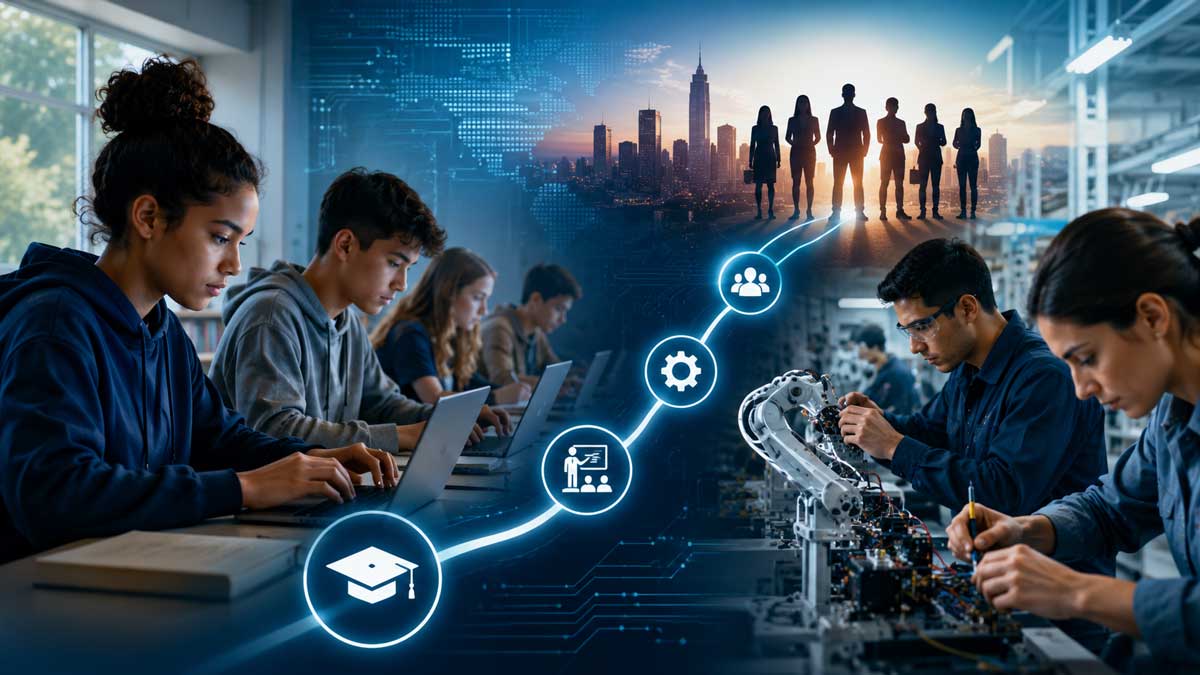
As artificial intelligence reshapes the workplace, experts argue the United States needs a coordinated workforce transition system that connects education directly to employment rather than focusing only on job displacement. The long-established P-TECH public school model is being highlighted as a practical framework that could help prepare both new graduates and experienced workers for an AI-driven economy.
The employment impact of AI is expected to involve job transformation more often than job replacement. According to the International Labour Organization, one in four workers worldwide is employed in occupations exposed to generative AI. However, because most jobs still require human judgment, communication and decision-making, the organization concludes that AI is more likely to change how work is performed than eliminate occupations entirely.
At the same time, labor shortages remain significant across several professions. Georgetown University’s Center on Education and the Workforce projects that by 2032 the United States will face shortages of approximately 611,000 teaching professionals and 362,000 nursing workers. While AI is expected to influence careers in education, healthcare, accounting, law and consulting, these fields will continue to rely heavily on human expertise and interpersonal skills.
Supporters of workforce reform argue that preparing workers requires more than short-term training. Successful career transitions also depend on recognized qualifications, practical workplace experience and clear pathways into employment. Those challenges are particularly important for students entering the workforce, employees changing careers and communities where schools, colleges and employers often operate independently.
The P-TECH model was created in 2011 when New York City’s public school system partnered with the City University of New York and IBM to launch the first school in Brooklyn. Students earn both a high school diploma and a tuition-free associate degree while receiving mentoring, workplace exposure and paid internship opportunities.
“A big part of the education they receive is in workplace learning, workplace skills and project-based learning where they learn how to solve problems,” said Tina Kelley, Senior Director of Engagement and Communications at P-TECH Alliance.
The program connects high schools, community colleges and industry partners to design curricula aligned with entry-level careers. Employers help define technical and workplace skills, while educational institutions translate those requirements into classroom instruction. Students complete college coursework alongside high school studies and participate in job shadowing, mentoring and internships before graduation.
The model has expanded beyond computer science and engineering into healthcare, biotechnology, advanced manufacturing and teaching as employer needs have evolved. Kelley said, “Business partners are offering real-life challenges for students. That enables us to always be up to date.”
Independent evaluations have found encouraging outcomes. A study of seven New York City P-TECH schools reported that participants were 38 percentage points more likely to complete internships during high school. After four years, 46% had enrolled in college courses compared with 20% of similar students, while seven years after entering high school they were five percentage points more likely to have earned an associate degree. Colorado data also shows that 57% of P-TECH graduates continue to four-year universities, including many first-generation, multilingual and economically disadvantaged students.
P-TECH graduate and current IBM robotic process automation leader Dr. ShuDon Brown said, “Struggling within and ultimately passing college courses as a young teenager taught me that I was capable, but graduating with my associate’s degree at 16 years old gave me confidence.”
Researchers noted that outcomes vary across individual programs and said additional evidence is needed regarding long-term results and cost-effectiveness. Even so, the findings suggest schools, colleges and employers can work together to provide structured pathways into employment rather than leaving students to navigate separate systems independently.
Kaela Mainsah, Vice President of Environmental Justice at the New York Power Authority, said the statewide P-TECH network and its partners can strengthen New York’s energy workforce by transforming education into direct employment opportunities.
Experts also believe the model could be adapted for adults changing careers. Community colleges could serve as the foundation while employers identify occupations with sustained regional demand. Shorter training modules, industry-recognized credentials, paid apprenticeships and flexible scheduling could allow workers to develop AI literacy alongside industry-specific knowledge without leaving the workforce for extended periods.
Employers would continue to play a central role by updating curricula, providing mentors, offering workplace learning opportunities and giving qualified graduates priority consideration for available positions.
“Industry partners in P-TECH transform education by co-designing curricula that embed professional training directly into rigorous academic coursework. This approach allows students to immediately apply classroom knowledge to real-world technical projects, ensuring mastery of both critical thinking and essential workplace skills,” said Rashid Ferrod Davis, founding principal of the Brooklyn P-TECH school. “By facilitating mentorship and paid internships, these partnerships bridge the gap between high school, college, and high-wage careers.”
Supporters also stress the need for safeguards, including portable credentials that remain valuable across employers, transparent reporting on graduation and employment outcomes, and ongoing evaluation of workforce programs based on labor market demand. While P-TECH is not viewed as a complete solution to AI’s impact on employment, advocates believe its collaborative structure provides a practical foundation for preparing future workers and helping displaced employees transition into evolving careers.






Related Articles
College Admissions Face Growing Calls for Greater Transparency
Colleges and universities across the United States are facing renewed scrutiny over...

New Student Loan Rules Bring Major Changes for Future Borrowers
New federal student loan regulations took effect on July 1, introducing significant...

Google AI Tutor Shows Strong Learning Gains in Classroom Trial
Google DeepMind has released findings from a classroom study in Sierra Leone...


High School Graduation Standards Face an AI-Era Overhaul
As graduation ceremonies take place across the United States, millions of students...
Leave a comment