




Boston Dynamics Simplifies Atlas Robot for Mass Production
 193cc Agency CouncilJuly 3, 20263 Mins read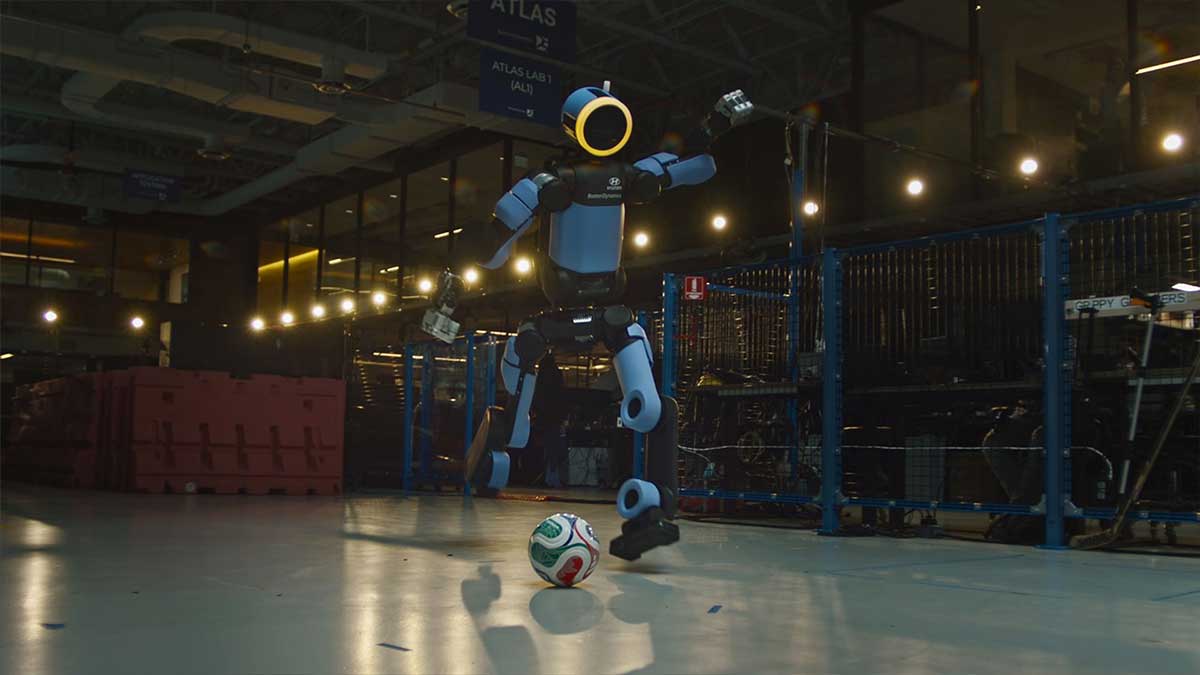
Boston Dynamics says its fifth-generation Atlas humanoid robot represents a major step toward large-scale commercial deployment after dramatically reducing the machine’s complexity while improving performance, reliability, and manufacturing efficiency. The latest version of Atlas, introduced at CES earlier this year, has already drawn worldwide attention for its advanced capabilities, including a soccer demonstration released as part of Hyundai’s FIFA World Cup 2026 campaign.
According to Alberto Rodriguez, Boston Dynamics’ Director of Robot Behavior for Atlas, the new robot features “almost an order of magnitude reduction in complexity compared to the previous generation.” He explained that the redesign significantly cuts the number of components and unique parts, making Atlas faster and easier to manufacture while increasing reliability and lowering production costs. Rodriguez noted that the reduction is not a full tenfold decrease, but is still substantial enough to mark a major advancement for the platform.
The simplified design is expected to help Boston Dynamics transition Atlas from an expensive research robot into a commercially scalable product. Earlier versions of Atlas carried a price tag exceeding $200,000, but the company now aims to make the humanoid more affordable through streamlined production. Hyundai, which recently acquired the remaining 20% stake in Boston Dynamics, plans to use most or all of this year’s production internally before expanding manufacturing to at least 30,000 Atlas robots annually for broader commercial availability.
Rodriguez said the company has maintained or improved Atlas’ performance despite its simpler design. “We’re happy that we’ve been able to demonstrate the same level of performance, or higher, with a robot that is fundamentally way, way simpler,” he said, adding that the approach places Boston Dynamics in a strong position for the next stage of mass manufacturing.
The company believes reducing the number of unique components is essential for scaling production because it shortens assembly time, lowers supply chain complexity, improves reliability, and reduces manufacturing costs. Boston Dynamics is positioning Atlas not only as a highly capable robot but also as a practical business solution that can be produced in large volumes.
Rodriguez emphasized that future improvements will depend as much on software as hardware. He said a robot’s capabilities are unlocked through increasingly advanced control systems, describing physical intelligence and reasoning intelligence as two complementary layers. Physical intelligence enables Atlas to balance, move, manipulate objects, and perform agile motions, while reasoning intelligence allows the robot to understand tasks, make judgments, and adapt to changing environments without requiring extensive reprogramming.
The company has invested heavily in reasoning AI to enable Atlas to learn from demonstrations and experience, allowing it to adjust to evolving factory workflows more naturally. Rodriguez said the goal is to eliminate the need for months of software redevelopment whenever industrial processes change.
Boston Dynamics also plans to leverage technology developed for Stretch, its warehouse automation robot, by integrating Atlas into fleet management systems that coordinate multiple robots and connect with existing warehouse and factory software. This experience, already deployed across hundreds of customer sites, gives the company an operational advantage as it expands Atlas into industrial settings.
Addressing the debate over legs versus wheels, Rodriguez argued that legged robots are not significantly more mechanically complex than wheeled omnidirectional platforms. He explained that both systems require a similar number of actuators, while legs provide greater mobility in factories by navigating loading docks, mezzanines, uneven surfaces, and confined spaces more effectively. He also said maintaining balance has become a solved engineering challenge, stating, “It’s actually not that difficult anymore. We’ve figured out the right recipes for how to do it reliably.”
Atlas recently showcased its agility in Hyundai Motor’s “Next Starts Now” campaign for the FIFA World Cup 2026. The robot learned advanced football skills and successfully performed a complex “Ghost Rabona” kick, with Boston Dynamics confirming every movement was executed by the robot itself without computer-generated imagery.
The latest Atlas represents Boston Dynamics’ strategy of combining simplified hardware, advanced AI, scalable manufacturing, and industrial software integration to transform its flagship humanoid robot from a technological showcase into a commercially viable product for widespread deployment.






Related Articles

PocketBook Q eReader With E Ink Carta 1300 Debuts at IFA 2026
PocketBook is preparing to introduce its new PocketBook Q eReader at IFA...
Google Gemini for Home Update Brings Better Spotify Controls
Google has released a new update for its Google Home app and...
Garmin Fenix 9 Launches With Brighter OLED and 64GB Storage
Garmin has unveiled the Fenix 9, the newest generation of its flagship...

Keychron V6 Ultra Hybrid Combines Mechanical and Magnetic Switches
Keychron has launched the V6 Ultra Hybrid on Kickstarter, introducing a full-size...
Leave a comment