





Private Craft En Route to Moon for First U.S. Landing in 52 Years
 193cc Agency CouncilFebruary 15, 20242 Mins read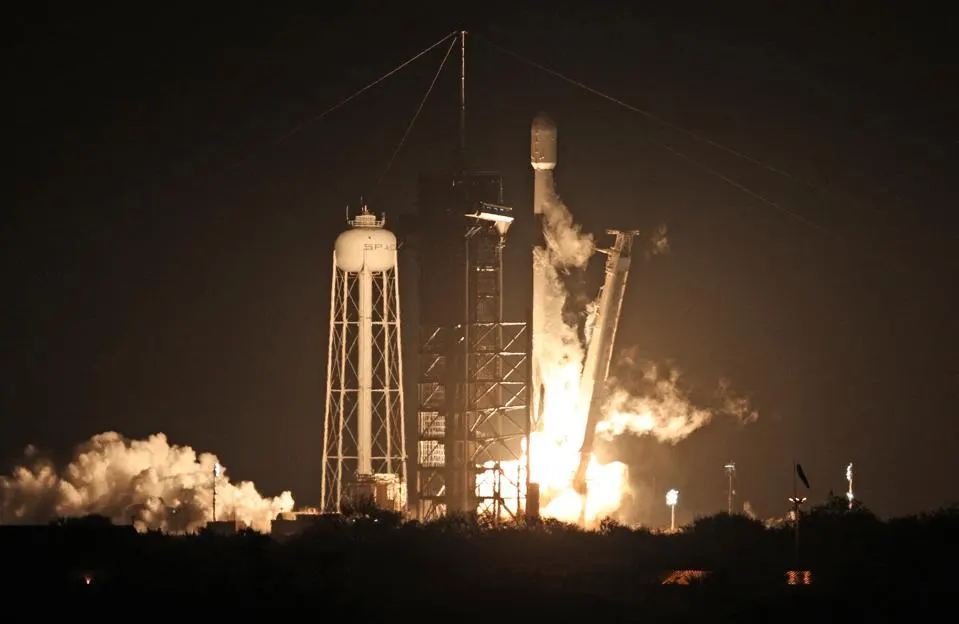
A private spacecraft launched by SpaceX is en route to the moon, with a potential landing as soon as next week. This mission, named 1M-1 and operated by Intuitive Machines from Houston, Texas, aims to soft-land the Nova-C lander at the moon’s South Pole on February 22. If successful, it will mark the first U.S. spacecraft to land on the moon since Apollo 17 in 1972. The spacecraft will operate for approximately one lunar day, equivalent to about 14 Earth days.
This mission follows Astrobotic’s Peregrine mission, which failed to reach the moon due to a propellant leak, and Japan’s successful ‘Moon Sniper’ rover landing, making Japan the fourth nation to achieve a soft landing on the moon after the U.S., China, and the Soviet Union.
The launch from Kennedy Space Center, Florida, occurred at 06:05 UT (1:05 a.m. EST) on February 15 after a 24-hour delay caused by temperature issues in the lander. The spacecraft was launched atop a reusable Falcon 9 rocket, and its booster safely landed back at Cape Canaveral. SpaceX confirmed the deployment of IM-1 on its journey to the moon.
The Nova-C lander, nicknamed Odysseus, is roughly twice the size of a king-size bed, with six legs and a cylinder shape. Its powered descent will reduce its velocity by about 1,800 meters per second, and its landing sequence will last approximately two minutes. It is set to land at a crater called Malapert A, near the moon’s south pole, where parts of the crater’s interior are almost constantly in darkness.
Odysseus is carrying five NASA payloads and will conduct experiments in radio astronomy and space weather, among others. This mission is part of NASA’s CLPS program, which aims to leverage private industry to develop necessary hardware. As part of NASA’s Artemis program, which aims to return humans to the moon, IM-1 is the first in a series of missions by Intuitive Machines. The IM-2 mission is scheduled to land at the lunar south pole in 2024, and the IM-3 mission will take NASA payloads and a rover to explore the moon’s “lunar swirl” called Reiner Gamma on the western edge of the moon.
NASA recently postponed its Artemis II flight test, the first mission with crew aboard its SLS rocket and Orion spacecraft, to September 2025. This 10-day mission is intended to pave the way for Artemis III, which aims to land two crew members near the moon’s south pole, currently scheduled for no earlier than September 2026.






Related Articles
NASA Reveals Crater Left by SpaceX Falcon 9 on the Moon
NASA has released before-and-after images showing the impact site where an unmanned...

96% ‘Blood Moon’ Eclipse Will Light Up Skies on Aug. 27-28
Skywatchers have another major celestial event to look forward to later this...

July New Moon Begins Countdown to August 12 Total Solar Eclipse
The new moon arriving at 5:43 a.m. EDT on Tuesday, July 14,...


China’s Tianwen-2 Reaches Earth’s Rare Quasi-Moon Asteroid
China’s Tianwen-2 spacecraft has successfully arrived at 469219 Kamoʻoalewa, also known as...
Leave a comment