





Blaze Star Nova May Finally Appear in June 2026
 193cc Agency CouncilJune 2, 20262 Mins read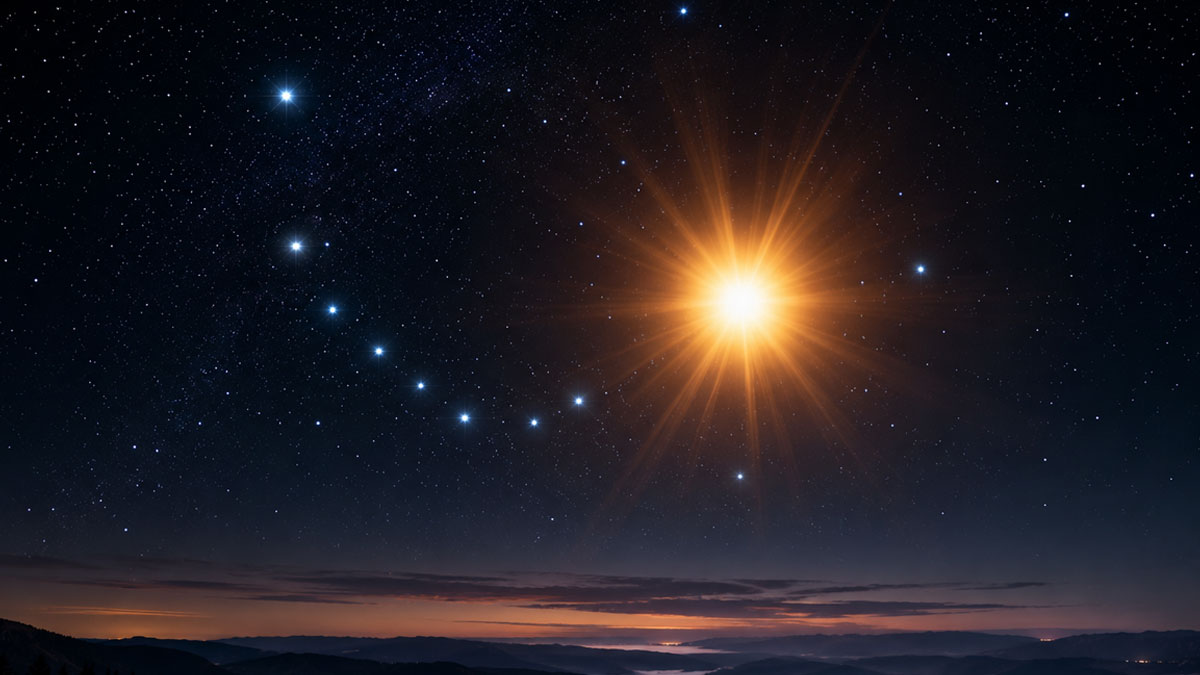
Astronomers are once again watching the skies closely as T Coronae Borealis, commonly known as the “Blaze Star,” approaches what researchers believe could be its long-awaited next eruption. After years of anticipation, scientists have identified June 25, 2026, as the statistically most likely date for the rare stellar event, which could briefly become visible to the naked eye.
Located about 3,000 light-years from the solar system, T Coronae Borealis lies within the constellation Corona Borealis, often called the Northern Crown. The crescent-shaped star pattern sits between the bright stars Vega and Arcturus. The system is classified as a recurrent nova and is known for erupting roughly once every 80 years, with previous recorded outbursts occurring in 1866 and 1946.
When the eruption occurs, astronomers expect the system to brighten dramatically from its normal 10th magnitude to around magnitude +2 or +3. That increase would make the star visible without telescopes or binoculars for several days or even weeks, creating one of the most unusual celestial displays available to casual observers. According to Sky & Telescope, if the eruption does not occur near June 25, 2026, the next most likely window would be February 8, 2027.
Although often described as an explosion, the phenomenon differs significantly from a supernova and does not destroy the star system. T Coronae Borealis consists of a red giant star and a dense white dwarf companion. Material expelled by the expanding red giant gradually accumulates on the white dwarf’s surface. Over time, enough matter builds up to trigger a thermonuclear reaction, causing the system to brighten suddenly before eventually fading back to its normal appearance.
Interest in the star intensified after astronomers observed a distinctive dimming pattern during 2023 and 2024 that closely resembled behavior seen before the system’s 1946 eruption. Those observations led researchers to closely monitor T Coronae Borealis and initially predict a possible eruption between April and September 2025. However, no outburst occurred during that period. A study published in Research Notes of the American Astronomical Society in October 2024 later identified June 25, 2026, as the most probable eruption date, with February 8, 2027, remaining a secondary possibility.
While the event has generated excitement among skywatchers, experts note that the Blaze Star will not become one of the brightest objects in the night sky. At its predicted brightness of magnitude +2 to +3, it will be comparable to familiar stars such as Polaris, Mizar and Alpheratz. Nevertheless, the sudden appearance of a bright star where none was previously visible is expected to make the eruption a memorable sight for observers around the world.






Related Articles
NASA Reveals Crater Left by SpaceX Falcon 9 on the Moon
NASA has released before-and-after images showing the impact site where an unmanned...
96% ‘Blood Moon’ Eclipse Will Light Up Skies on Aug. 27-28
Skywatchers have another major celestial event to look forward to later this...
July New Moon Begins Countdown to August 12 Total Solar Eclipse
The new moon arriving at 5:43 a.m. EDT on Tuesday, July 14,...


China’s Tianwen-2 Reaches Earth’s Rare Quasi-Moon Asteroid
China’s Tianwen-2 spacecraft has successfully arrived at 469219 Kamoʻoalewa, also known as...
Leave a comment